Tuesday, May 28, 2013

May 15th

At NTNU today, we were educated in the multiple therapy of traditional Chinese Medicine: Food therapy Tui Na Therapy and Acupressure, Cupping Method and Acupuncture. Our instructor briefly went over the first few topics and then he focused on the acupuncture.


So how does it work? It results in the excretion, or an increase in the flow of endocrines, endorphins, inferferon's, antibodies, and red and white blood cells, which relieve pain, reduce inflammation and improve circulation and organ functions. Or, in short, it balances the functions and flow within all the body's systems and bring all of these systems into harmony with each other restoring the body its original, natural condition.


Here, he shows us some of the first acupuncture needles that were used.


He thought I looked stressed so he tried to help me a little.


After we were done getting poked with needles, we took a tour of NTNU's new library.


Their new library is very modern, hi-tech and beautifully designed. There are around 35 touch screens that access news stations, online newspapers, information about the university and the library.


Our lovely tour guides showed us the history of the school and the library, the milestones that the school has achieved, their past presidents and their new very cool display: the virtual yearbook. Here, you can search any class of any year.


The Virtual Yearbook


After our tour, we went off to the main train station food court for lunch. During our walk, through the food court on the street level floor; the city began to conduct a city wide emergency alert exercise. This is not like the EMS *beeeeeeep* you see on TV were it just interrupts what you’re watching. This citywide exercise for when the country is under attack by a foreign power, massive earthquake or some other disaster. As we were walking through the train station, you can hear the loud fallout sirens (like in the movies) and a small army of civil service personnel began to escort every citizen to the lower levels of the train station. As we ascended down the escalators to the lower levels, it seems like all the lights behind us began to turn off. And when we finally got down to the bottom level, there were so many people just crowded around the video screens and TVs watching the local news station as they began to speak about the drill and why they were conducting it. It was very interesting and pretty cool because for a second there, it felt like I was a part of a disaster movie that was being filmed or a part of a real disaster that was unfolding somewhere on the street level. (video coming soon)

After lunch, we met Albert at the mobile phone company HTC headquarters. We took a tour about of the main offices and he spoke about the company itself. They are celebrating their 15th year in business. They have made incredible strides in the realm of mobile phone technology. They allowed us to handle and play with the new HTC ONE smartphone. One of the best features on the phone is the rapid fire picture-taking capability and the capability to record videos AND take pictures at the same time. You can even record a video, play it back on your phone and take pictures from the video that you just recorded. I'm 95% sure this may be my next phone.
This is some artwork in their front lobby.


Dr. Laurence, Dr. Peng and our HTC host Albert


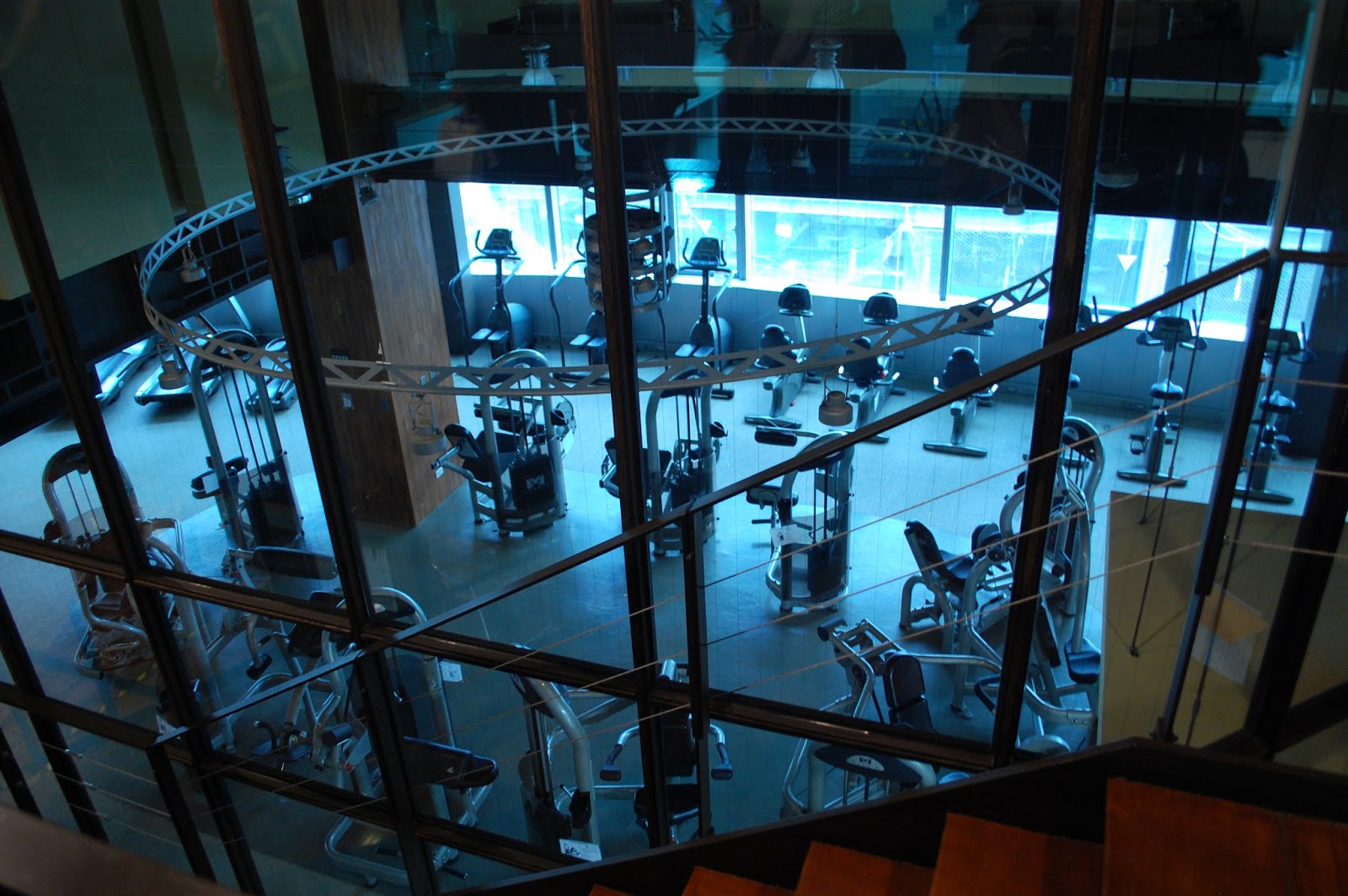
Like most of the other companies that we have visited, they believe that healthy employees make a healthy company. Here are some of the amenities that the HTC employees have at the disposal...

Spin Room


Boxing Ring


Weight Lifting Area


Yoga/Dance Studio


and a great view of the city and terrain.


After we departed HTC, we went over to Taipei 101 for dinner and then we went to the Observation Deck. 


Their elevator was listed as the Guinness Book of World Records as the fastest elevator in the world. We went from the 6th floor to the 89th floor in about 60 seconds. And the most interesting thing is that you couldn't even feel the gravitational forces on your body but your ears did pop. 


Since we went to the Observation Deck just past the dusk, the views of the city of Taipei was just incredible.


It was interesting that there is a 660 ton metal "Ball Damper" the helps reduce the buildings vibration from high wind and other natural factors by 40%. This "ball" is so large that the construction company had to take it up in pieces and construct it at the top of the building, 101 floors up.


What the ball damper looks like.


A technical aspect of the "ball damper."


My camera lens wasn't wide enough to get a great shot.


I had to walk up one level for a better view.


Monday, May 27, 2013

May 14th

After another great breakfast from the hotel, we traveled over to National Taiwanese Normal University (NTNU).


Upon arrival, we were led into a classroom where teacher Jennifer Huang began to teach us “Survival Chinese.” This, basically, was a crash course in everyday saying in Chinese: greetings, introducing yourself, goodbyes, numbers and proper pronunciation. She explained to us the four different tones that the Chinese us when they speak. One word can be spelled the same but if you use the incorrect tone, the word changes it meaning.


After our Survival class, the NTNU School of Management conducted a welcoming receptions for us. We were greeted by the dean of the school and one of the head professors of the school of management.


And during this reception, we met our “overseas friend.” These were students that were assigned to us, individually, as an ambassador for the school. My ambassador was Zola Li. She was a business finance major at NTNU and she is an accomplished violinist (she's on the left).


After meeting and getting to know our new friends at N.T.N.U., we traveled over to the Taipei 101 Building for a visit to KPMG Taipei, one of the largest professional services companies in the world and they are apart of the Big Four auditors along with Deloitte, Ernst and Young, PricewaterhouseCoopers.


An accounting firm that was founded by Andres Chang in 1952 in Taiwan, they built a reputation that helped them become associated with Peat Marwick, Mitchell and Co. in 1971, making it one of the oldest international accounting firms in Taiwan. Then in 1987, they became a member of KPMG after the worldwide mega-merge of accounting firms PMI and KMG. They currently are representing multinational companies like Panasonic, Pepsico, Citibank, Nestle, General Electric, Motorola and Microsoft.


The view from their offices.


The view from their boardroom.


After lunch, we visited another large company in Taipei: ASUS Computer company.


ASUS is becoming one of the leaders in technology by focusing on the mastery of technological innovation and design perfection. Starting out by just developing and building computer motherboards, they have branched out to hard drives, graphic cards and even their own brand name laptop. They have won many awards including 3 Year Best Lowest Malfunction by Manufacturer, Best Motherboard by PCWorld and Top Laptop in 2011 by PC Magazine. In fact, ASUS has earned 4,168 awards in 2012 from innovation and design to Tech Brand of the Year. Currently, they are #2 worldwide in Consumer Portable PC sales, #4 in Tablet Market and #1 in Motherboard Brand sales.

One of the courtyards that teams can get together and think.


Since ASUS is a very forward thinking company, they believe that "healthy mind, healthy employee, healthy company." So they invested into some amenities to make that happen.

Basketball court


Weight Room


Swimming Pool


 Therapy and Jacuzzi pool


With all the warm, humid weather that we were walking around in, it was hard to not to jump into that pool fully clothed.

Monday, May 20, 2013

May 13th

After a great breakfast the our hotel served up, we went to a tea shop that has be family owned and operated for over 100 years. The Wang Tea company has been making tea the old fashioned way: by hand.


The great-grandson of the founder of the Wang tea company the process in which they were sorted actual tea leaves from the leaves and the stalk. In many large corporate tea companies use machines for this process and allot of the times they separate about 85%-90% of the leaves and the stalk unlike conducting this process by hand and getting 100% separation.


After the leaves are separated, they are taken into a special room so they can be dried out using a special heating process. First, there is this tunnel-like design where all the heat that is created is sealed off and then transferred. The Wang tea company uses a temperature of about 100 degrees Celsius (212 degree Fahrenheit).


The heat is transferred through these tunnel-like areas to where the containers that hold the tea are located. This process takes about 2-3 weeks.


To properly control the heat, you can see that they place charcoal under the tea containers so they the charcoal can nominally dispense a constant amount of heat instead of an uneven amount which and destroy the tea leaf batch.


When this process is done, they package the product that the Wang family has been making for over 100 years for sale. The Wang family has ventured out from just making tea to now marketing and selling tea sets, tea cups/mugs, flavored tea and other tea related products.


After visiting the Wang tea company, we had lunch at a very nice restaurant. I was very surprised when I was handed a special menu where we had to select our seven course meal. This is what I ordered:

First: Seasonal Fruit Salad
4.5 out of 5 stars

Second: Baked King Oyster Mushroom
4 out of 5 stars

Third: Geoduck and Fish Conomme
3.7 out of 5 stars

Fourth: Salmon Rice with Scallions
4 out of 5 stars

Fifth: Mulberry Vinegar Juice
5 out of 5 stars

Sixth: Beef Steak with Garlic and Plum Season
4.8 out of 5 stars

And last, Seventh: Mango Yogurt Creme Brulee
4 out of 5 stars

Since we couldn't head back to the hotel and take a quick nap, the last thing of the day was venturing off to the National Palace Museum, the national museum of the Republic of China in Taipei, Taiwan. This museum hosts almost 700,000 pieces of ancient Chinese artifacts and artworks collection encompasses over 8,000 years of Chinese history. Allot of the pieces on display are collections from ancient Chinese emperors. This is one of the largest museums in the world. We weren't allowed to take pictures inside the museum so many of the pictures I have are scenic of the buildings and surrounding terrain which was very beautiful.


Sunday, May 12, 2013

May 12th - Big First Day

After a few very long plane flights and a short night sleep, we had a great first day of the trip. And the best thing about this day was I was so excited about, I didn't even feel like I was jet lagged even if I were. And due to some technical difficulty, I'm currently unable to to load some of the amazing pictures that I have taken. I will take and correct this problem as quickly as possible. I received my name tag and I was ready to go.


First stop: Confucius Temple.

The Confucius Temple was incredible and enchanting. Harrison Lee, our tour guide, was Quite possibly the most upbeat person that I have ever encountered he was the definition of "a person who loves his job." He told us that there is a Chinese saying that "people who come and visit you while its raining are good friends of yours." and that because we visited while it was raining, we were meant to return in the future because we are now friends with the Confucius Temple. And it was raining. It seemed like mother nature was flipping the on and off the switch for the rain several times. It felt like it would rain for ten minutes, stop and start again. Mr. Lee was very knowledgeable and he explained so much in such great detail about Confucius, his sayings, his teachings and his life, it made it very easy for us students to better understand and apply his wisdom to our own lives. I think what made it even better was that, while he was telling us about the teachings, he would include some of his own personal experiences. There were so much interesting information about Confucius that it made me reflect about my own personal experiences. The building itself was just incredible. The strong detail in the design of the building and the stories that it told was just amazing. Confucius say, "Watch your step." My classmates know what I mean.


After the temple visit, we headed to the central subway to catch a train to Taipei and have lunch. Since we had a short time to eat and the central subway terminal was so large (New York City's Penn Station large) we didn't have much of  chance to full investigate the (quite possibly) hundreds of restaurants and eateries in the building. So I figured I'd play it safe, Burger King. That's right. With all the culture and different tastes to explore, a BK Double stacker was my decision. But I did find out something interesting: on the BK menu, they had a Double bacon, mashed potato cheeseburger. I thought, "Nope. I'm even gonna try it." And it's a whole new experience for me to pay with New Taiwan Dollars. My small burger, fries and drink was about $155. It first, my head exploded but then I had to remember where I was at and with what currency I was paying: $155 NTD x $.035 USD = $5.43 USD. O.K., that's better. I felt like a high roller carrying around thousands of Taiwan dollars when in fact, its worth about $250 USD.

Yup, these are real burgers that they sell in Taiwan. Who buys them? I don't know.


After lunch, we visited the equivalency of the White House: the Presidential Office Building. And as thought, our bags were searched and we walked through a metal detector. It wasn't that bad. It was actually pretty quick and painless. Inside the building, we were told that we can take pictures but we cannot record and video for security purposes. Inside, we learned about the construction of the building and the design influences on the building. We were also shown many graphical timelines that were related to the atmosphere surrounding the country and its people both financially and politically. There was all of information to absorb during our tour and and most it was intriguing to me because showed the different occupations of Taiwan by Japan and China. Lots of politics. The one timeline that I found the most interesting was exports. We're all familiar with the phrase "Made in Taiwan" in this timeline proved it. In the 1950s and 1960s, Taiwan only had agriculture exports. The 1970s to present, it was mostly manufacturing electrical products. A dominating force in the fried of electronics. Now that I look back on this visit, I should have taken a picture with the cardboard cut-out of the current president. That would have been funny.


After the Presidential visit, we once again trekked through the rain to the National Taiwan Museum. This museum had practically everything Taiwan-related: history of clothing designs, historical artifacts, even the different kinds of bugs and fish that inhabited the the country. We journeyed across the street to another part of the museum where they had dinosaur artifacts on display. Instead of a guided tour, we were allowed to explore on our own. I really enjoyed this part of the day because as students, we were really able to bond with one another and become friends instead of having those awkward moments of trying to think of someones name because you only talked to that once or twice.


After the museum visit, we went to The Red House Marketplace. This was a large are with shopping, restaurants, bars, and an area where many different people sold their homemade goods. We spent about an hour and half here getting to know each other and having dinner and some drinks. It was nice that the rain let up for a little while but no matter what, we were going to have a good time.

Overall, after a grueling 15 hour trip and a 5 hour nap, my first full day was allot of fun and educational.