Today was the day that I was waiting for the whole trip: Hiroshima Peace Park and A-Bomb Museum. Just a fair warning, some of the images that I was be displaying may be considered graphic in nature.
We got off the train and waled toward the Peace Park. The city of Hiroshima is a city that is on the rise. It is very modern and could be another other medium metropolitan city in the world. Just by walking down the street, you would have never known that an atomic bomb had been dropped on the city. There are allot of different statues that memorize different things so most of this blog will be photos that I have taken.
The plaque of the ruins of the Hiroshima Gas Co.
A-Bomb Victim - the Momument of Hiroshima. This monument was design to remind everyone of the victims that died so miserably by the explosion of the A-bomb and roof tiles that melted by the heat rays. The bubbles or blistered changes on the surface of the roof tiles showed that they were burned by an unimaginably high temperature. This monument is 141m south of the hypocenter (meaning: below the center). The Motoyasu River, which laps the river wall, was full of dead citizens.
This monument reads, "The Lions club of Hiroshima and Nagasaki sister cities, having experienced the tragedy of atomic bombing, erect this monument as a symbol of eternal peace for mankind."
The Hiroshima Prefectural Commercial Exhibition Hall, built in 1915, was a base for promoting the sale of goods produced in Hiroshima Prefecture. When the A-bomb exploded, it ravaged the building instantly. Heat blazing from above engulfed the entire building killing everyone in it. Along with the wire framework of the dome, these form the shape that has become a symbol. It is now known as the "A-bomb Dome."


During World War II, more than 3,000,000 students over 12 years old were mobilized for labor services throughout the country. As a result, more than 10,000 students were killed including around 6,000 killed by the atomic bomb. They gave up their youth and studies for their nation. The tower below was erected by concerned families and friends to console the souls of these victims who sacrificed themselves for their homeland and who could have had a promising future had there been no war. The ferro-concrete tower (below) is 12m high and gradually widens as it rises. The exterior surfaces of the five tiers are finished with Arita-yaki ceramic tiles. The sculpture depicts the Goddess of Peace accompanied by eight doves perched around the tower. On the center pole are lights offered to God in memory of the thousands of young lives that were extinguished by the blast.
Some true stories to remind us about the aftermath of atomic weapons.
Some other monument in the Peace Park.
The Children's Peace Monument
This monument standing memory of all the innocent children who died as a result of the atomic bombing. The monument was originally inspired by the death of Sadako Sasaki, who was exposed to radiation from the atomic bomb at the age of two. Ten years later, she developed leukemia that ultimately ended her life.
The Hiroshima Peace Park Memorial
The Hiroshima Peace Memorial Museum
Established in August 1955, the museum exhibit presents the facts of the atomic bombing with the purpose of contributing to the abolition of nuclear weapons throughout the world and of promoting world peace. It is the most popular of Hiroshima's destinations for school field-trips from all over Japan and for international visitors.
Images from inside the museum
"A dragonfly flitted in front of me and stopped on a fence. I stood up, took off my cap in my hands and was about to catch the dragonfly when...."
A letter from Albert Einstein to President Roosevelt
There were allot of informational plaques about the science and politics behind the dropping of the atomic bomb.
The first meeting of "The Target Committee," which comprised of military personnel and scientists, was on April 27, 1945. Some of the criteria for target selection by the committee examined the topography (the study of surface shape) would most magnify the effects of the atomic blast.
A letter explaining that the bomb will be delivered when and if the weather will permit it.
A scale model of Hiroshima August 6, 1945 at 8:13am
Hiroshima three minutes later
In this picture, you can see the "A-bomb Dome" towards the middle. The red stick on the right shows where the atomic bomb exploded over Hiroshima. The atomic bomb was suppose to detonate over the bridge near the upper left corner.
"The Viewfinder Clouded with Tears"
(below)
Photo and written by Yoshito Matsushige
"I fought with myself for 3 minutes before I could take the first picture. After taking the first, I grew strangely calm and wanted to get closer. I took about ten steps forward and tried to snap another, but the scenes I saw were so gruesome my viewfinder clouded with tears."
This picture was taken 2,270m from the hypocenter, west end of the Miyuki Bridge, Senda-machi 3-chome about 11am, August 6th, 1945 by Yoshito Matsushige.
The over three million lives lost in World War II were a deep wound and sadness for Japan. At the time, almost everyone agreed that was is a horrible thing. Particularly regarding soldiers returning to civilian life and others returning from overseas, stories abounded of the most profound misfortune. Even today, there are stories of many Japanese who were detained at labor camps in Siberia long after the end of World War II or who were stranded in China as children or wives (depicted below). Their efforts to return to Japan evoke an eerie sense of a war as yet unfinished.
A-bombed horse. I didn't get a full picture but just like his mouth had been burned from the heat blast, so were all four of his legs from the knee down. The rest of its story is in the picture.
A simulated version of the rumble after the bomb
A re-creation of a photo of a family trying to walk away from Hiroshima after the blast. The heat flash began to melt the skin of their bodies as they tried to escape the city.
Many survivors felt like they were lucky to survive the blast but at what costs?
A model of where the atomic bomb exploded.
Summer uniform and chemise of a 13 year old female student, 800 meters from blast.
Replica of the Hiroshima bomb (actual size)
A tricycle and metal helmet (below)
Donated by Nobuo Tetsutani
1,500 m from the hypocenter, Higashi-hakushima-choShinichi Tetsutani (then 3 years and 11 months) loved to ride this tricycle. That morning, he was riding in front of his house when, in a sudden flash, he and his tricycle were badly burned. He died that night. His father felt he was too young to be buried in a lonely grave away from home, and thinking he could still play with the tricycle, he buried Shinichi with the tricycle in the backyard. In the summer of 1985, forty years later, his father dug up Shinichi's remains and transferred them to the family grave.This tricycle and helmet, after sleeping for 40 years in the backyard with Shinichi, were donated to the Peace Memorial Museum.
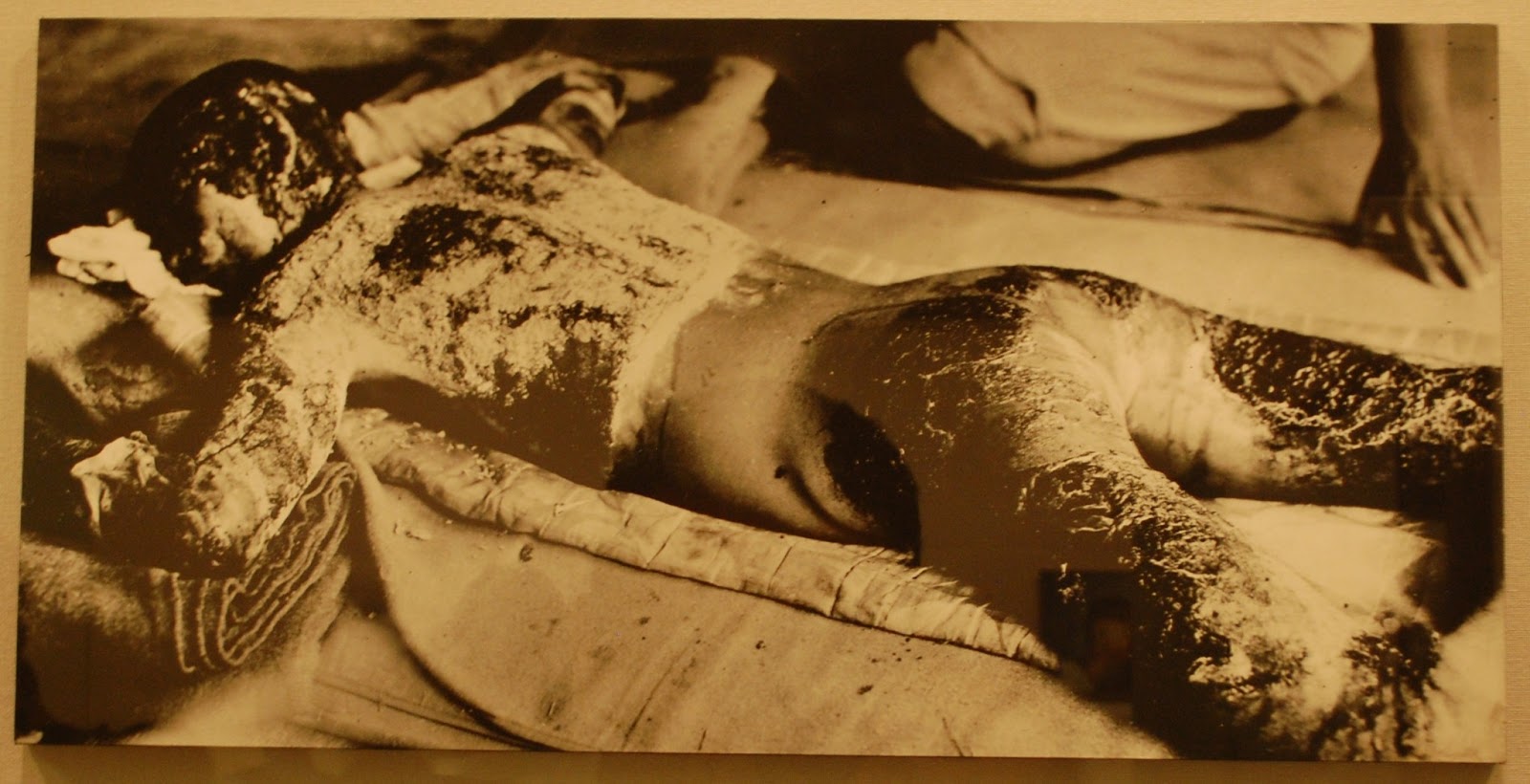
A man with burns over his entire body
This picture was taken at the Army Transport Quaratine Station on Ninoshima Island, 9,000 meters from the hypocenter. Thousands of survivors were brought to this quarantine station in the same condition for treatment. Most of them died.
This woman, exposed to the heat flash, suffered burns on her body in the same pattern of the dress she was wearing at the time.
The museum was filled with so much information that I could have spent a 5 days there just to read all the historical, political, military, social, psychological, scientific and financial information about this time in world history.
"White Wall Stained by Black Rain"
(below)
The roof of a house about 3,700 meters west of the hypocenter was dislodged by the blast, allowing in drops of black rain that dripped down and left traces on this white plaster wall. Analysis of this rain revealed that it contained radioactive fallout from the atomic bomb explosion. Many of the survivors that struggled in the ruins of Hiroshima didn't know about the contaminated rain water. These adults and children drank and cleaned themselves with the "black rain" exposing themselves even more to radioactive material guaranteeing their ultimate demise.
This is a petition collection box that asks all visitors to sign a ballot in support for a nuclear weapons convention taking place in 2020. This will try and sway world leaders to stop the research and development of nuclear weapons. I signed one.
This little statue was pointed out to us and I found this pretty interesting. We were told that this statue survived the atomic bomb blast but the more interesting thing is that the dark shaded area around the base was "the shadow of the statue was burned into the stone from the flash." It took me awhile to wrap my head around the idea that the shadow, a silhouette of an object that blocks light, could burn into something. As a one-time engineering student, I felt like there is ALWAYS an explanation why something happens. No one could really explain it to us but I did some research about this phenomenon and it is possible only when nature and science cross paths in an extreme way.

This was quite possibly the most emotionally and mentally draining day of my life. I wish that we could have spent more time here because there is so much interesting information that I felt I rushed through just so I wasn't the last person to leave. After a long trying day, it was time for some dinner and head back to the hotel to relax and unwind. I'm glad that I had this experience in my life.